Using course outline data, we identified 639 BCIT instructors who taught a ZTC course from 2025S to 2026W. We contacted 150 of the instructors with an invitation to complete a ZTC feedback survey, and gained consent to use non-personally-identifiable responses to help promote ZTC. We divided our invitations by BCIT’s six schools.
Over 20% of the instructors we invited responded to the survey!
Question 1: Which BCIT school(s) do you currently teach in?
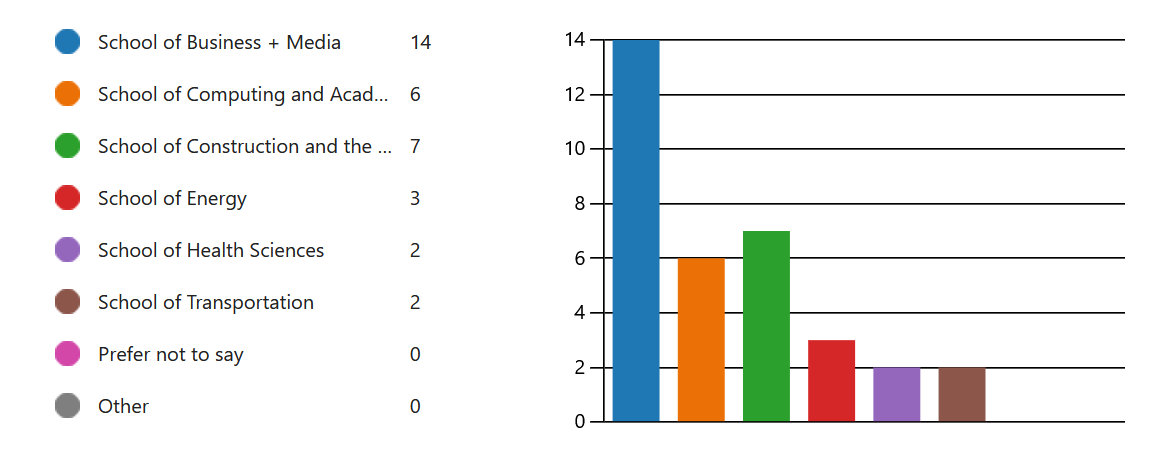
Number of survey respondents by school:
- School of Business + Media: 14
- School of Computing and Academic Studies: 6
- School of Construction and the Environment: 7
- School of Energy: 3
- School of Health Sciences: 2
- School of Transportation: 2
- Prefer not to say: 0
- Other: 0
Question 2: What motivated you to adopt the Zero Textbook Cost initiative for your course(s)? (For example, student access, equity, flexibility, teaching philosophy, OER support.)
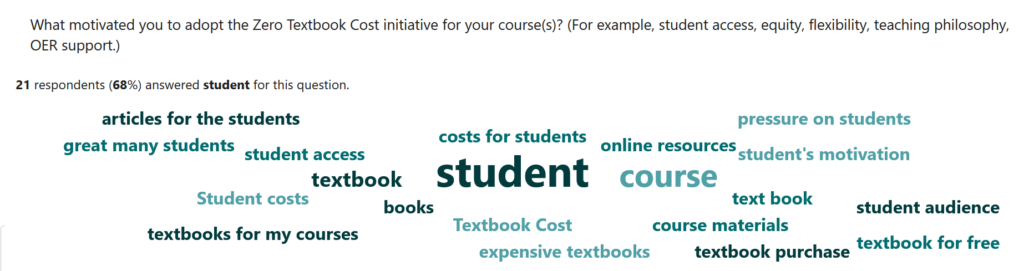
This word cloud of the responses shows that 68% of respondents mentioned students. “Student” is the largest word, and the other words and phrases sorted alphabetically are:
- articles for the students
- books
- costs for students
- course
- course materials
- expensive textbooks
- great many students
- online resources
- pressure on students
- student access
- student audience
- student costs
- student’s motivation
- text book
- textbook
- textbook cost
- textbook for free
- textbook purchase
- textbooks for my courses
“I adopted the Zero Textbook Cost initiative primarily to improve student access and equity. I don’t want cost to be a barrier to learning, and this ensures all students have the required materials from the first day of class.
It also aligns with my teaching philosophy. The courses I teach are skills-based and industry-driven, and I often use current, real-world examples rather than a single static textbook. This flexibility improves relevance while reducing unnecessary financial pressure on students.”
BCIT School of Business + Media instructor
The ZTC Project Team used more survey responses to create open resources anyone can use to promote Zero Textbook Cost at their institution.
Question 3: From your perspective, what impact has ZTC had on students? (For example, affordability, participation, preparedness, or positive learning outcomes.)
We received 30 responses to this question, with students (15 respondents) and affordability (12 respondents) being the most commonly used words.
“The original aim was to have higher quality material specifically designed for this course. ZTC followed naturally from that.”
BCIT School of Computing and Academic Studies instructor
The ZTC Project Team used more survey responses to create open resources anyone can use to promote Zero Textbook Cost at their institution.
Question 4: Can you share a specific moment, story, or example that stands out from your ZTC experience?
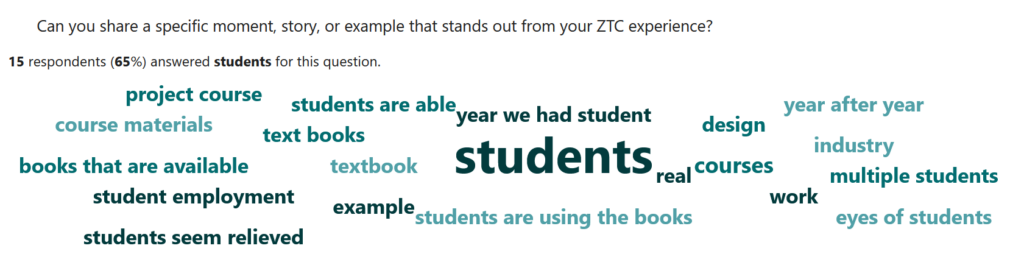
This word cloud of the responses shows that 65% of respondents mentioned students. “Students” is the largest word, and the other words and phrases sorted alphabetically are:
- books that are available
- course materials
- courses
- design
- example
- eyes of students
- industry
- multiple students
- project course
- real
- student employment
- students are able
- students are using the books
- students seem relieved
- text books
- textbook
- work
- year after year
- year we had student
“One time I took a copy of the ‘new’ revision of an Operations Management textbook that I was obliged to use and put it beside the ‘old’ version. I went through them page-by-page, word-for-word. NO actual content was changed. The only changes were to the graphic design and the photos used. The section on the ISO9000 standard was 16 YEARS OUT-OF-DATE! There was a calculation example that was erroneous, and the error had been pointed out online for many years, and they STILL hadn’t corrected it.”
BCIT School of Business + Media instructor
The ZTC Project Team used more survey responses to create open resources anyone can use to promote Zero Textbook Cost at their institution.
Question 5: What advice would you give to an instructor who is considering adopting ZTC for the first time?
Some faculty quotes:
“Work with your librarian and ask your peers – there is SO much free reputable information out there. You don’t have to find them – the library already knows and wants to help!”
– BCIT School of Health Sciences instructor
“Provide the core theory yourself while having students gather current industrial and literature-based information—using BCIT’s rich digital library and OER support.”
– BCIT School of Energy and School of Construction and the Environment instructor
“Go for it! Contact a librarian at BCIT, They will help you find resources. There are already many excellent resources available there too.”
– BCIT School of Construction and the Environment instructor
More responses can be viewed as open resources you can use to help promote ZTC.